Machine Learning Platform project policies
This page describes the policies that govern the lifetime of a project on the Machine Learning Platform (MLP): project types, recorded project data, compute and storage budgets, and the rules for a project’s start, duration and end.
These policies are specific to the MLP. They complement, and where they differ take precedence over, the general CSCS user policies. Formulas and worked examples for compute consumption are collected in the appendix.
Project types
Every MLP project is either small or large depending on the type of proposal submitted (large proposal can be reduced to a small grant instead of being rejected). The type determines the project’s duration and how its start date is set. The compute budget is only a guideline for which type to apply for. For more information see the Swiss AI Initiative Compute Grants.
| Small | Large | |
|---|---|---|
| Typical compute budget | ≤ 32,000 GPUh | ≳ 500,000 GPUh |
| Duration | 6 months | 12 months |
| Start | Rolling start | Fixed start |
| Storage budget | Optional in proposal (defaults apply) | Mandatory in proposal |
Core project data
Recorded for every project at proposal time, and managed through the project management tool:
- Project kind — small or large.
- Project ID — unique identifier.
- Project title.
- Principal investigators (PIs) and deputy PIs — the project administrators. Only institutional email addresses are accepted; personal addresses (for example generic webmail accounts) cannot be used.
- Compute budget — in GPU hours (GPUh), corresponding to a credit in CHF (see compute budget).
- Storage budget — space (TB) and inodes (see storage budget).
- Scientific fields — the project’s research areas.
- Start date — fixed for large projects; derived from the creation date for small projects.
- Duration — 6 months (small) or 12 months (large).
Compute budget
Your compute budget is granted in GPU hours (GPUh) and corresponds to a credit in CHF according to node-hour price for swiss institutions at the start of the project. The cost per hour is fixed for the whole duration of the project (the price can be seen in the resource). Because a GH200 node has four GPUs, one node-hour of a GH200 node costs 4 GPUh. The jobs that you submit get billed according to the node-hours that they run.
Job cost example
A 3 hours 4-nodes job on Clariden will be billed as 12 node-hours (48 GPUh), and with the swiss institutional prices of 2026 (2.69 CHF) means 32.28 CHF
You are expected to use your credit roughly linearly over the project: every month has an expected consumption, the amount you should use that month. The expected consumption is also used to set your scheduling priority through Slurm fair-share.
- You can consume more than the expected amount without any issue, and only run at lower priority as you get ahead of your schedule.
- Each month also has a minimal consumption — the expected amount reduced by a grace of 15% to 50% (depending on your budget size). If you consume less than expected but stay above this minimal, the unused credit rolls over to the following months, so you can still catch up later. If you fall below the minimal, the credit between your usage and that minimal is lost.
If you use up your credit before the end of the project, you can run extra jobs in the low partition.
This is not guaranteed, since jobs run only when the cluster has spare capacity and at lower priority, and it is capped at the equivalent of one month of your budget.
Once that is also exhausted, the project can no longer use compute resources.
The usage for a project can be seen in the project dashboard on portal.cscs.ch where you have an overview showing the your usage for current month, and how it is with respect to the expected and ideal usage, and the global credit usage.
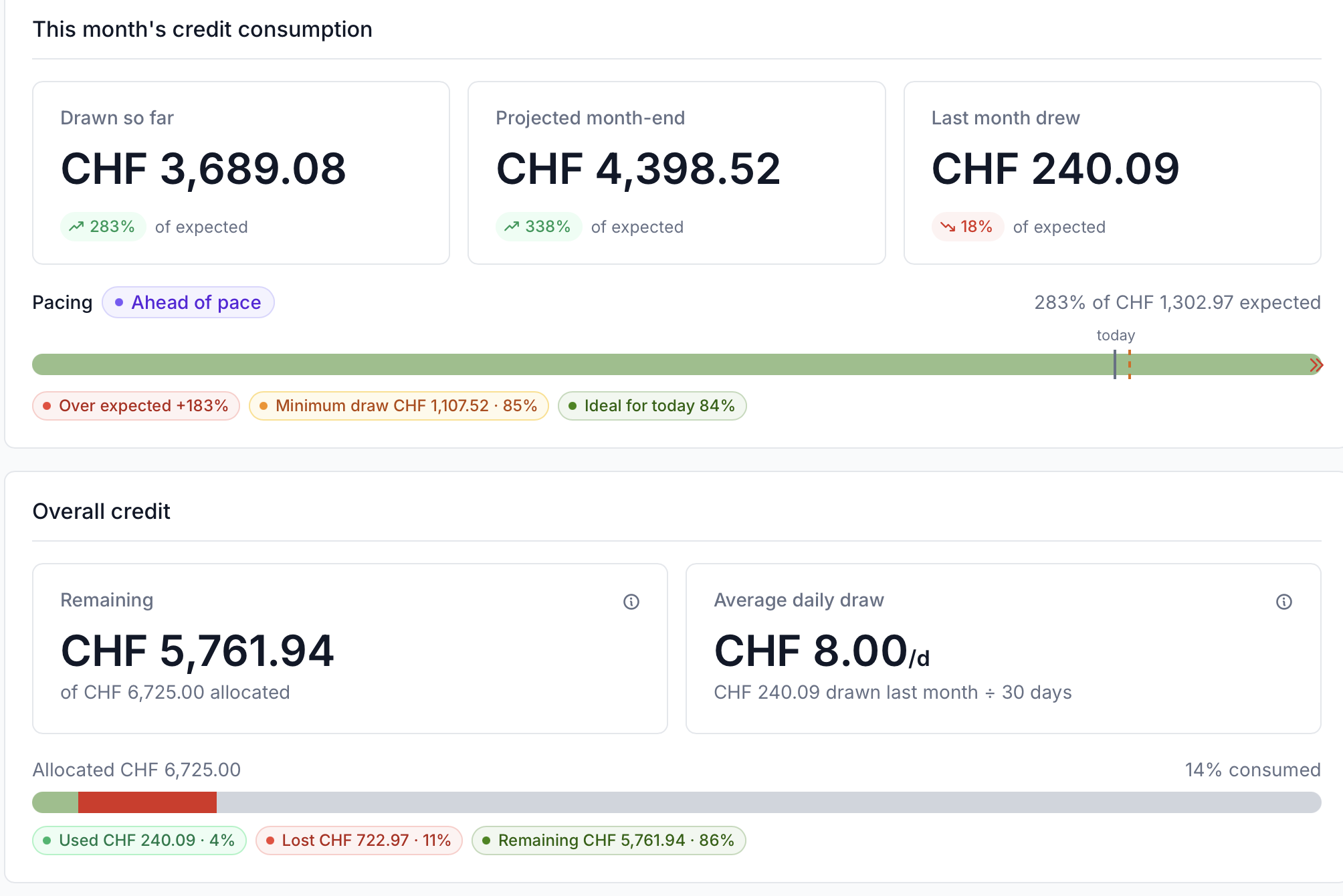
Above an example of a project that has been below pace in the past months (and has thus lost some unused credit), but is much ahead of pace for the current month.
See the appendix for how the expected consumption, the grace and the monthly threshold are computed, with worked examples.
Storage budget
The storage budget sets two quotas on project storage: the space (in TB) and the number of inodes (files and directories).
- Small projects need not specify a storage budget; if none is requested, the default of 1 TB and 1,000,000 inodes applies.
- Large projects must specify their storage budget in the proposal, and no default is applied.
CSCS reviews the requested quota and reserves the right to adjust it.
Check current usage against the quota with the quota command on a login node.
After the project ends
When a project ends, it remains accessible for a grace period of 90 days for data retrieval: only the storage systems are accessible, and compute resources can no longer be used.
See the general data retention policies for how long data is kept and backed up after a project expires.
Other resources
The main resource for the computation is Clariden, it is the one where we guarantee availability of the computational resources (if you use them gradually). Depending on the project you might also access to other resources.
- A project directory as persistent storage (described in the previous section)
- The x86 cluster Bristen
- Inference API Service
Currently storage is not explicitly part of the credit, but the other resources are billed on your credit, using them reduces the credit and thus the node hours that can be used on clariden. Please note that the availability of other resources is not necessarily guaranteed, and can be limited and on a best effort basis (like bristen).
Start
How a project’s start date is set depends on its type.
Small projects: rolling start
Small projects start in a rolling fashion, as soon as they are accepted. The effective start date, from which the 6-month duration is counted, defaults to the first day of the following month, and can be delayed by up to 3 months on request of the PI.
The time between creation and the effective start date is a preparatory period: the project is already active and usable, but jobs run at low priority, balanced by Slurm fair-share. The duration and the compute budget only start counting from the effective start date.
default and postponed start
A small project created on 15 March starts on 1 April by default, and runs until the end of September. On request of the PI it may instead start as late as 1 June (within the 3-month limit). Until the effective start date the project is usable, but at low priority.
Large projects: fixed start
Large projects start at the scheduled time of the call they were submitted to, normally 1 July or 1 January. The 12-month duration and the compute budget start counting from that date.
Unlike small projects, a large project has no preparatory period: it is expected to be ready to run at scale from its start date. For this reason a large allocation is often preceded by a small project, used to get familiar with the systems and prepare the workflows before committing to a large allocation.
Duration
- Small projects have a duration of 6 months.
- Large projects have a duration of 12 months.
Users and job priority
All users of a project have the same priority when running jobs, and there are no per-user limits: any member of a project can draw on the full project budget.
Per-user consumption can be tracked and is available through the CSCS portal.
Appendix: computing compute consumption
The exact rules behind the compute budget: how the grace, the expected consumption and the monthly minimal threshold are computed, with worked examples.
Grace
How far a project is allowed to fall behind the linear schedule is governed by its grace, a fixed percentage set once, at allocation time, from the total initial credit:
- credit ≤ 10,000 GPUh gives a grace of 50%,
- credit ≥ 100,000 GPUh gives a grace of 15%,
- between 10,000 and 100,000 GPUh the grace is linearly interpolated between 50% and 15%:
The grace is fixed for the project’s lifetime; larger allocations get a smaller grace, as they are expected to keep the systems more consistently busy.
| Total credit | Grace |
|---|---|
| 6,000 GPUh | 50.0% |
| 10,000 GPUh | 50.0% |
| 30,000 GPUh | 42.2% |
| 55,000 GPUh | 32.5% |
| 100,000 GPUh | 15.0% |
| 250,000 GPUh | 15.0% |
Expected and minimal consumption
The expected and minimal consumption are recomputed every month, so that credit left unspent in one month can still be used later — up to a point.
At the start of month m (with duration the project length in months):
-
the expected consumption for the month is the amount that should be used to finish the credit at the end of the project plus the amount that has been graced:
`expected(m) = (credit - consumed(m-1) - graced(m-1))*(m / duration) + graced(m)
-
the minimal consumption is a floor below the expected, obtained by allowing a shortfall of at most
grace:minimal(m) = (1 − grace) × expected(m)
At the end of the month, let used be the credit consumed during the month:
- if
used ≥ minimal(m), nothing is lost, and the unspent part of the expected,graced(m) = max(0, expected(m) − used), rolls over and raises next month’s expected consumption; - if
used < minimal(m), the shortfall down to the floor,minimal(m) − used, is permanently lost (used(m) = minimal), and only the part of the expected above the floor,graced(m) = expected(m) − minimal(m), rolls over.
In both cases the month is accounted for max(used, minimal(m)) GPUh — the credit consumed, plus any credit forfeited — and this is what the next month’s expected subtracts.
consuming ahead of schedule
You can always consume more than the expected amount.
If a project is already ahead of the linear line, having accounted for more than target(m), then expected(m) is zero or negative: there is no minimal to meet for the month, and the project is never penalised for having used its credit early.
Running ahead of schedule only lowers your scheduling priority through Slurm fair-share, until your consumption falls back in line with the schedule.
a small project that keeps up
A small project is granted 6,000 GPUh over 6 months. Because the credit is below 10,000 GPUh, the grace is 50%. Ideal is the perfectly linear consumption
| Month | Accounted so far | ideal |
expected |
minimal (50%) |
|---|---|---|---|---|
| 1 | 0 | 1,000 | 1,000 | 500 |
| 2 | 750 | 2,000 | 1,250 | 625 |
| 3 | 2,000 | 3,000 | 1,000 | 500 |
In month 1 the project uses 750 GPUh, above the 500 GPUh minimal, so nothing is lost.
It ended the month 250 GPUh behind the line, so in month 2 the expected consumption rises to 2,000 − 750 = 1,250 GPUh (equivalently (6,000 − 1,000)/5 + 250), with a minimal of 625 GPUh.
a small project that dips below the minimal consumption
Take the same project at the start of month 3, where the expected consumption is 1,000 GPUh and the minimal is 500 GPUh. This time it consumes only 200 GPUh during the month, below the 500 GPUh floor.
- The shortfall down to the floor,
500 − 200 = 300 GPUh, is permanently lost. - The part of the expected above the floor,
1,000 − 500 = 500 GPUh, rolls over.
Month 4 therefore starts with an expected consumption of 1,000 + 500 = 1,500 GPUh and a minimal of 750 GPUh.